

Medicare does cover bariatric surgery, but you have to certain your personal case fits within the coverage guidelines.
The article below contains all you need to know about getting bariatric surgery covered by Medicare.
TABLE OF CONTENTS
Click on any of the topics below to jump directly to that section
- Definitions
- Over 65 Patients
- Qualify
- Apply for Medicare
- Patient Community & Expert Advice
- Find a Weight Loss Surgeon

Definitions: Medicare, Medigap, & Medicaid
SECTION SUMMARY:
- Medicare is for 65+, under 65 with disabilities, End-Stage Renal Disease
- Medigap is supplemental insurance for Medicare
- Medicaid is for low-income individuals or families
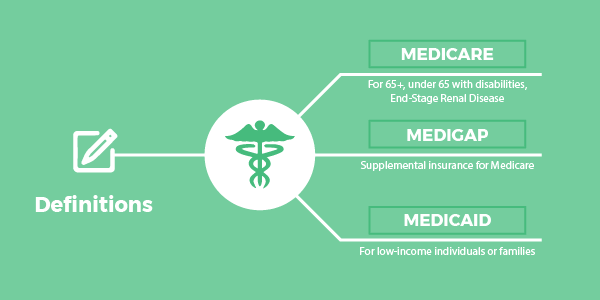
Medicare, Medigap, and Medicaid are government administered programs designed to expand access to health care.
1. Medicare
Medicare is a U.S. government-controlled health care program for people…
- 65 or older
- Under 65 with certain disabilities
- Any age with End-Stage Renal Disease (ESRD) (permanent kidney failure requiring dialysis or a kidney transplant)
Medicare has four separate parts, including:
Part A (Hospital insurance)
Qualifying individuals are usually automatically enrolled in part A unless explicitly choosing to enroll in a Medicare Advantage plan (Part C). Part A covers inpatient hospital and skilled nursing facility care, home health services and hospice care (not long-term custodial care).
As long as you or your spouse paid Medicare taxes during your working life, Part A will usually be offered at no charge. You also have the choice of paying for Part A (as a part of a Medicare Advantage plan, for example).
Part B (Medical insurance)
Part B covers outpatient care, doctor office visits, home health and some preventive services. If you receive Social Security or Railroad Retirement Board benefits, you will be automatically enrolled in Part B. Unless you opt out by sending the Medicare card back when it arrives, you will be billed accordingly.
Part C (Medicare Advantage program)
Medicare Advantage offers the benefits included under Part A and Part B in addition to other benefits such as prescription drugs, dental, vision or hearing. They also offer options to lower your out-of-pocket costs when using the plan. Most of plans require that you use a special network of doctors and hospitals (i.e. HMO, PPO, etc.).
Medicare Advantage is offered through insurance companies that have been approved by the government, although it is not available in all states.
Part D (Prescription drug coverage)
Medicare prescription drug coverage is available to everyone enrolled in Medicare and is offered through private companies that have been approved by the government. Medicare-eligible individuals have the option of purchasing Part D along with the traditional Parts A and B or as a part of a Medicare Advantage plan (Part C).
2. Medigap
Medigap, also known as Medicare Supplemental Insurance, covers costs that Parts A through D do not. As with Medicare Advantage, as long as you qualify for Medicare you can purchase Medigap coverage through approved insurance companies or a broker that represents them.
3. Medicaid
Medicaid programs are state-run programs established for low-income individuals or families. Medicaid pays medical benefits directly to providers (doctors, hospitals, pharmacies, etc.) for “Qualified Medicare Beneficiaries.” If you qualify, each state has its own requirements and may or may not pay for the surgery.
Bariatric Surgery for Patients Over 65
SECTION SUMMARY:
- Patients over the age of 65 have similar benefits from weight loss surgery and no additional risks compared to patients under 65
- A lower percentage of seniors will qualify for weight loss surgery due to higher surgery risks for older patients
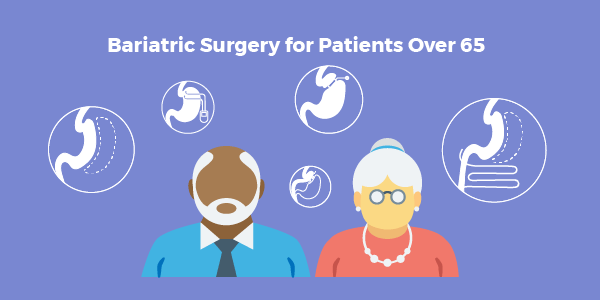
There are contradicting opinions about whether or not weight loss surgery is safe and effective for people 65 years of age and older…
Arguments for:
- Two studies (300+ participants) evaluated patients over the age of 65 and found that bariatric surgery for seniors has similar benefits and no additional risks compared to patients under 65 (REF)(REF) .
- One study showed that after two years, older patients lost almost 76% of their excess weight (REF).
- A study of 3,000 participants showed that patients over 60:
Arguments against:
- A 2006 aggregate study (over 25,000 total patients) showed that seniors experience less weight loss and more complications than younger patients and concluded that, “Limiting bariatric surgical procedures to those younger than 65 years is warranted because of the high morbidity and mortality associated with these operations in older patients.”
According to the Centers for Medicare and Medicaid Services (CMS):
“The Centers for Medicare & Medicaid Services (CMS) has determined that the evidence is adequate to conclude that open and laparoscopic Roux-en-Y gastric bypass (RYGBP), laparoscopic adjustable gastric banding (LAGB), [laparoscopic sleeve gastrectomy (gastric sleeve surgery – added to covered bariatric surgeries in 2012)], and open and laparoscopic biliopancreatic diversion with duodenal switch (BPD/DS), are reasonable and necessary for Medicare beneficiaries who have a body-mass index (BMI) > 35, have at least one co-morbidity related to obesity, and have been previously unsuccessful with medical treatment for obesity.”
Take a look at the CMS web site to read their entire opinion.
The takeaway is that bariatric surgery may be appropriate for people over 65 depending on each individual’s situation, but it is likely that a lower percentage of seniors will qualify for surgery than those under 65 years of age.
The best way to determine whether surgery is right for you is to discuss it with your primary care physician and a reputable local weight loss surgeon.
Most surgeons offer free seminars that teach you about your options and their office’s specific results. The seminars also allow you to get to know the surgeon prior to a one-on-one consultation (usually free as well).
You can also click here to learn how to evaluate and interview potential bariatric surgeons.
Qualify
SECTION SUMMARY:
- Medicare covers bariatric surgery in all states
- Medicaid covers bariatric surgery in all states
- You need a body mass index (BMI) of 35 or higher with accompanying health issues to qualify for weight loss surgery
Medicaid coverage for bariatric surgery is decided on a state by state basis – some states cover it and some do not.
To find and contact your state’s Medicaid office, click here.
Medicare has determined that bariatric surgery is appropriate for the treatment of obesity as long as the patient has…
- A body mass index (BMI) greater than 35 (see our BMI Formula page for more on body mass index)
- At least one co-morbidity related to obesity
- Has documentation in their medical records confirming that previous attempts at medical treatment for obesity have been unsuccessful
If all of the above apply, the surgery must be one of the following types…
- Gastric bypass surgery (open or laparoscopic)
- Lap band surgery (laparoscopic only)
- Gastric sleeve surgery (laparoscopic only)
- Biliopancreatic diversion with duodenal switch (BPD/DS) (open or laparoscopic)
Medicare does not currently cover the gastric balloon procedure.
To get approved, you’ll need to be referred by your primary care physician or other attending doctor (probably not just a self-referral to a bariatric surgeon). In their referral to a bariatric surgeon, your physician should refer to the obesity health problems that are expected to improve after surgery.
Bariatric Surgery Facility Certification (Center of Excellence) Requirements
The Centers for Medicare and Medicaid Services (CMS) no longer require weight loss surgery hospitals and facility to be designated Centers of Excellence in order to be covered.
According to CMS, "the evidence is sufficient to conclude that continuing the requirement for certification for bariatric surgery facilities would not improve health outcomes for Medicare beneficiaries. Therefore, CMS has decided to remove this certification requirement."
For more information about the change, click here.
If you obtain/have traditional Medicare coverage, you’ll need to choose a facility that meets the Centers for Medicare and Medicaid Services’ minimum facility standards and certification requirements for Medicare bariatric surgery. Click here to search their directory.
If you choose/have Medicare Advantage, you’ll need to verify that your chosen surgical team and their hospital are in your insurance company’s network. Call your insurance company directly to find out.
Regardless of which Medicare plan you have or are applying for, talk with your surgeon to find out if they accept Medicare/Medicare Advantage. They may have some especially useful tips on how to streamline the process with Medicare Advantage insurance companies in your area.
Medicare Options & How to Apply
SECTION SUMMARY:
- Medicare Part A, B, C, & D Explained
- Call (800)MEDICARE to apply
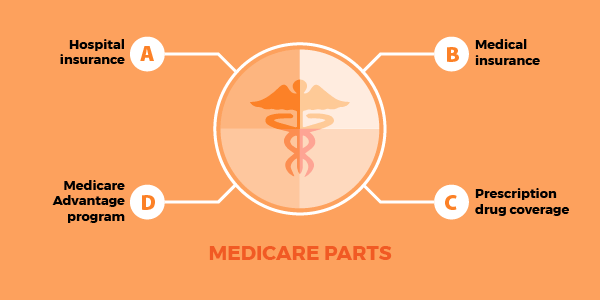
Applying for coverage for a Medicare plan depends on your goals and situation. As long as you meet the eligibility criteria described above, following are your options:
Part A (Hospital insurance)
As explained above, qualifying individuals are usually automatically enrolled in part A unless explicitly choosing to enroll in a Medicare Advantage plan (Part C described below). As long as you or your spouse paid Medicare taxes during your working life, Part A will usually be offered at no charge.
You also have the choice to pay for Part A as a part of a Medicare Advantage plan.
Part B (Medical insurance)
If you receive Social Security, you will be automatically enrolled in Part B.
If you do not, you can apply for both Social Security and Medicare at the same time three months before the month you turn 65. See Medicare.gov for more information.
You can also enroll in Part B via a Medicare Advantage program…
Part C (Medicare Advantage program)
If you want more robust benefits than Parts A and B offer including prescription drugs, dental, vision or hearing and the option for lower out-of-pocket costs for doctor and hospital visits, Medicare Advantage is the way to go.
Part D (Prescription drug coverage)
To obtain Medicare Prescription Drug coverage, you are required to have Medicare Part A and/or Part B. To get prescription drug coverage through a Medicare Advantage Plan, enrollment in Part A and Part B is mandatory.
Medigap
Just like Medicare Advantage, Medicare Supplement Plans are offered through government-approved insurance companies. While you can work with insurance companies directly, we recommend working with a qualified broker to help you compare multiple insurance companies and choose the option that’s best for you.
Call (800)MEDICARE for traditional plans or work with your Medicare Advantage plan to add it to your Medicare Advantage policy.
Patient Community & Expert Advice
SECTION SUMMARY:
- You can read about other patients’ experiences getting weight loss surgery covered by Medicare
- You can “ask the expert”

We would love to hear your experiences with medicare and bariatric surgery. Your insights are invaluable to making sure other people have the tools to meet their goals.
We would also be happy to answer any questions you may have about medicare and bariatric surgery.
Please use the form below to share your experience or ask a question.
Questions From Other Visitors*
Click below to see contributions from other visitors to this page.
I started a bariatric program and am scheduled to have gastric sleeve surgery in a week. I am a senior (65 years old) and not in the best health. I…
Find a Weight Loss Surgeon
SECTION SUMMARY:
- You can ask a local bariatric practice if they accept Medicare
- You can attend a free in-person seminar or an online webinar offered by a local weight loss surgeon
- You should schedule a phone or in-person consultation (both often free), if you are interested in learning more about weight loss surgery