

Child obesity statistics and teenage obesity statistics have been tracked since 1963 (1) (2). Between then and now, the rate of obese children and teens has gone from about 4.5% (1 in 22) to almost 17% (1 in 6).
This page breaks down the childhood obesity statistics (6 to 11 years old) and teen obesity statistics (12 to 19 years old). Note that obesity in children and teens is classified as having an age- and gender-specific body mass index at or above the 95th percentile.
TABLE OF CONTENTS
Click on any of the topics below to jump directly to that section
- By Geography
- By Age & Gender
- By Age and Race/Ethnicity
- Impact of Childhood Obesity
- Find a Weight Loss Surgeon
SECTION SUMMARY:
- Sharp increases in obesity began in the 1970’s
Both males and females have seen significant increases in obesity rates over the last 45 years, although the rate of obese female children and teenagers is now slightly lower than that of obese males.
For children aged 6 to 11, the obesity rates for boys and girls were virtually identical until around 1999 when the rate of obese boys began to increase at a faster rate. As of the latest data, 21.2% of boys were obese compared to 18% of girls.
Teenagers aged 12 to 19 have shown a similar trend, with obesity in male teenagers most recently reaching 19.3% versus obese female teenagers who were most recently recorded at 16.8%.
The following chart and spreadsheet compare three groups for the childhood and teenage age ranges:
- Both genders
- Male only
- Female only
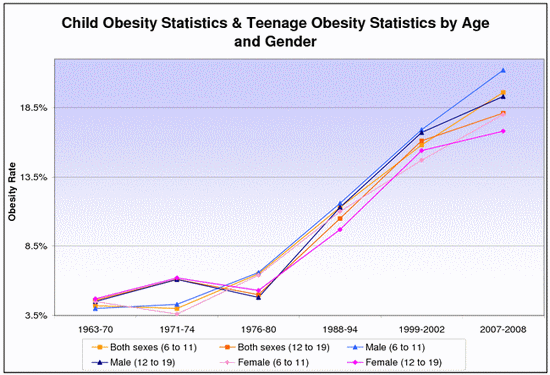
Obesity Percentages By Age and Gender
Tap here to see a chart of obesity percentages by age and gender.
| 1963 -70 | 1971 -74 | 1976 -80 | 1988 -94 | 1999 -2002 | 2007 -08 | |
|---|---|---|---|---|---|---|
| Both (6-11) | 4.2% | 4.0% | 6.5% | 11.3% | 15.8% | 19.6% |
| Both (12-19) | 4.6% | 6.1% | 5.0% | 10.5% | 16.1% | 18.1% |
| Male (6-11) | 4.0% | 4.3% | 6.6% | 11.6% | 16.9% | 21.2% |
| Male (12-19) | 4.5% | 6.1% | 4.8% | 11.3% | 16.7% | 19.3% |
| Female (6-11) | 4.5% | 3.6% | 6.4% | 11.0% | 14.7% | 18.0% |
| Female (12-19) | 4.7% | 6.2% | 5.3% | 9.7% | 15.4% | 16.8% |
SECTION SUMMARY:
- Sharp increases in the late 1970’s
- Some groups decline in obesity in the late 1990’s
Childhood and teen obesity statistics broken out by race/ethnicity have been available since 1976 for 3 ethnicities:
- Blacks/African Americans
- Hispanics/Latinos
- Whites
Of the three ethnicities evaluated, Hispanics/Latinos have the highest childhood obesity rates (6 to 11 years old) while African Americans have the highest teenage obesity rates (12 to 19 years old).
Whites had the lowest obesity rates in both age groups, although the obesity rates for whites were still alarmingly high at 19% of children and 15.6% of teens.
The following spreadsheet and chart compares the 3 tracked ethnicities for both the childhood and teen age groups:
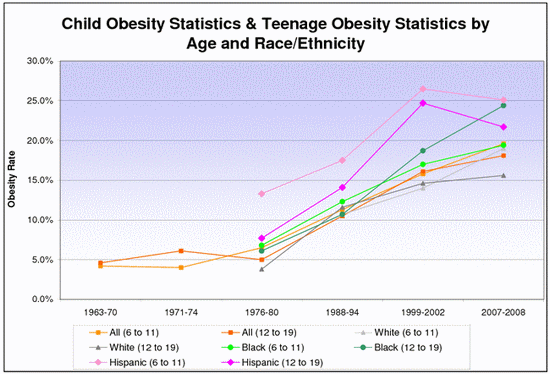
Obesity Percentages By Age and Ethnicity
Tap here to expand a chart of obesity percentages by age and ethnicity.
| 1963 -70 | 1971 -74 | 1976 -80 | 1988 -94 | 1999 -2002 | 2007 -08 | |
|---|---|---|---|---|---|---|
| All (6-11) | 4.2% | 4.0% | 6.5% | 11.3% | 15.8% | 19.6% |
| All (12-19) | 4.6% | 6.1% | 5.0% | 10.5% | 16.1% | 18.1% |
| White (6-11) | n/a | n/a | 6.1% | 10.7% | 14.0% | 19.0% |
| White (12-19) | n/a | n/a | 3.8% | 11.6% | 14.6% | 15.6% |
| Black (6-11) | n/a | n/a | 6.8% | 12.3% | 17.0% | 19.4% |
| Black (12-19) | n/a | n/a | 6.1% | 10.7% | 18.7% | 24.4% |
| Latino (12-19) | n/a | n/a | 13.3% | 17.5% | 26.5% | 25.1% |
| Latino (12-19) | n/a | n/a | 7.7% | 14.1% | 24.7% | 21.7% |